
🗞️ Moonshot’s Kimi K3 sends Chinese AI into Fable-grade territory
Kimi K3’s Fable-grade AI leap, GLM-5.2 744B MoE on 25GB RAM, open agentic embedding models, Claude Code on agents vs automation, Grok Build under Apache 2.0, AI job-creation doubts, OpenAI’s hardware
Read time: 12 min
📚 Browse past editions here.
( I publish this newletter daily. Noise-free, actionable, applied-AI developments only).
⚡In today’s Edition (17-July-2026):
🗞️ Moonshot’s Kimi K3 sends Chinese AI into Fable-grade territory.
🗞️ Opinion: Kimi K3 Could Break the Frontier Model Profit Pool
🗞️ GLM-5.2 (744B MoE) on a 25GB-RAM consumer machine 👌
🗞️ A new family of open, commercially available embedding models built for agentic retrieval, code retrieval, and agent memory.
🗞️ AI agent does not remove the necessity of engineering automation. They are worth much more: Creator & Head of Claude Code at Anthropic
🗞️ SpaceXAI actually open-sourced Grok Build with Apache 2.0 license. 39 mints and 1.9K+ Github stars.
🗞️ Why “technology always creates new jobs” will not work this time.
🗞️ OpenAI launched its first hardware, codex Micro, a $230 desktop controller for managing workflow.
🗞️ Moonshot’s Kimi K3 sends Chinese AI into Fable-grade territory.
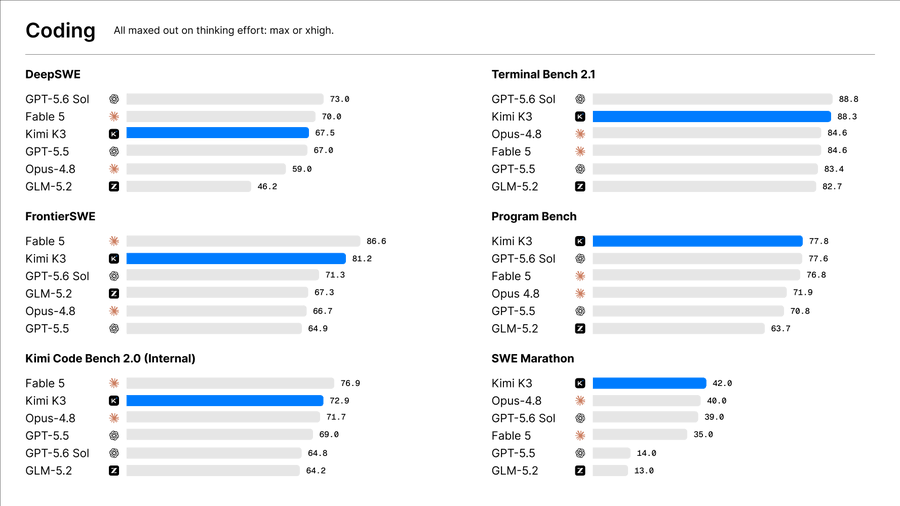
Beijing-based Moonshot AI’s Kimi K3 just dropped.
- 1 Mn token context window, natively multimodal. (i.e. 750,000 words of code or documentation in a single prompt.)
- Total 2.8 trillion params, but activates only 16 of its 896 experts at a time. That is roughly 1.8% of the expert pool per token.
- Some of the benchmarks put it Opus 4.8/ GPT 5.6 Sol / Fable 5 territory.
- Its Delta Attention enables up to 6.3x faster decoding in million-token contexts
- available via API at $3/$15 per million input/output tokens.
- K3’s 2.8T MXFP4 weights require roughly 1.4 TB before quantization metadata and runtime overhead.
At an assumed 115 GB usable per GB10 node (NVIDIA’s compact Grace Blackwell AI chip), 14–16 nodes is expected to hold the raw weights realistically. Including activations, KV cache and runtime memory etc.
Moonshot itself recommends supernodes containing 64 or more accelerators.
Some very cool findings from technical report
- K3 autonomously designed, optimized, and verified a working AI chip in a single 48-hour run—specifically to serve a smaller model built on K3’s own architecture.
The simulated chip reportedly reached 8,700+ tokens/second, contained 1.46 million standard cells, and fit within 4 mm².
- An early version of K3 handled the majority of the kernel-optimization work used to develop K3 itself.
- K3 built a GPU compiler from scratch. created MiniTriton, optimization passes, PTX generation, and runtime. Matched or beat Triton on some workloads and successfully trained nanoGPT end to end.
- In a 15-hour autonomous run, Kimi K3 redesigned a production-scale training kernel and cut forward-plus-backward time from 283.6 ms to 114.4 ms.
- For a 42-year semiconductor-industry report, Kimi says K3 performed 2,800+ web searches/fetches, 1,100+ terminal data pulls, processed 11,000+ pages, and recursively improved the work over 120+ rounds.
- K3 reproduced a computational-astrophysics research workflow in roughly two hours, versus an estimated one to two weeks for an experienced researcher. It reviewed 20+ papers, evaluated 300+ equations of state, found inconsistencies in published formulas, and wrote 3,000+ lines of Python.
Kimi K3 appears to beat every model shown on BrowseComp while costing only a fraction as much per task.
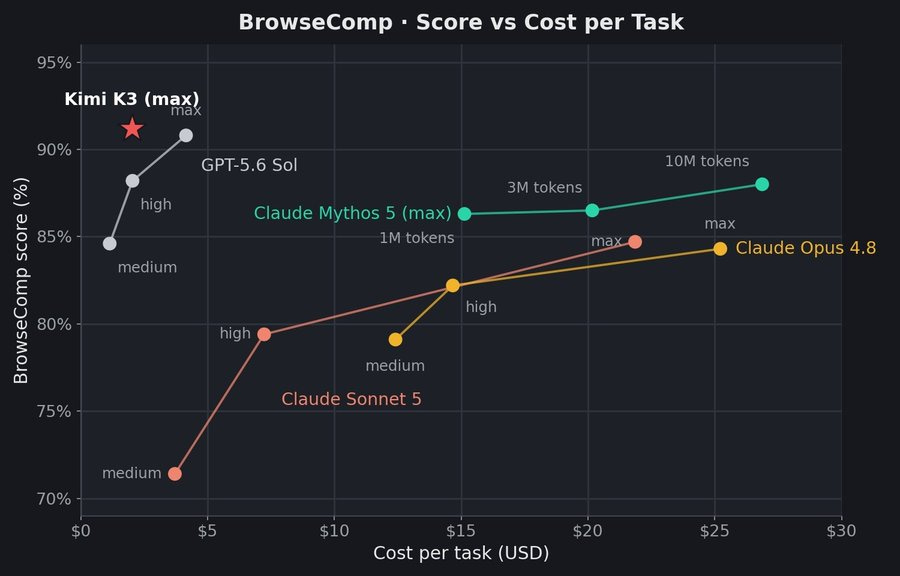
Its claiming a dramatically better intelligence-per-dollar tradeoff.
BrowseComp assesses the capability of an AI agent to repeatedly search the internet and discover obscure, hard-to-find facts that require multiple searches and validation.
i.e. a high BrowseComp score means you are good at deep research and web investigation, but not necessarily better general intelligence, writing, coding, or everyday browsing.
As a final note, in my opinion, what I’m seeing on the internet is that a lot of people want Kimi K3 to be framed as a distillation tale. Distillation might play a role, but it still does not explain how Chinese AI labs keep building, training, and releasing models this strong, this fast.
“they copied” is not an AI strategy. America needs its own open source plan.
🗞️ Opinion: Kimi K3 Could Break the Frontier Model Profit Pool
The biggest implication of Kimi K3 is not that an open-source model has matched the leading closed models. It is that frontier-level intelligence may be becoming a competitive market rather than a permanent oligopoly.
That shift would be painful for OpenAI and Anthropic, but broadly positive for almost every other part of the AI economy.
When only 2 or 3 labs control the best models, they can keep inference margins extremely high. Over time, that gives them enough economic power to move into data centers, chips, cloud infrastructure and software. They do not just supply the intelligence layer. They gradually absorb the layers above and below it.
More competition at the model layer changes that equation. Lower model margins mean more AI workloads, more infrastructure spending and more room for independent software companies to build profitable products. Chipmakers, power providers, hyperscalers, neoclouds and application companies all benefit when intelligence becomes cheaper and less concentrated.
The key metric is not benchmark performance or price per token by itself. It is intelligence per dollar.
That depends on both the cost of each token and how many tokens a model needs to complete a task. Kimi K3 appears competitive on headline token pricing, but its weak token efficiency may make it 50% to 70% more expensive per task than GPT-5.6. That limits how disruptive it is today. A genuinely transformative open-source model would need frontier performance, low serving costs and high intelligence density per token.
This also explains why frontier models from Google, Meta, SpaceX and other vertically integrated companies matter so much. These companies do not need to maximize margins at the model layer. They can make money through cloud services, advertising, hardware, subscriptions or other products. Their presence alone can stop independent model labs from sustaining unusually high margins.
OpenAI and Anthropic still have 2 possible defenses. Their consumer products, developer tools and agent harnesses may be stronger moats than the underlying models. They may also possess substantially more advanced internal systems that could give them an early lead in recursive self-improvement.
But the broader direction is becoming clearer: the companies that win will not necessarily own the highest-scoring model. They will deliver the most useful intelligence for every $1 spent. As frontier models become more competitive, value will move away from model access itself and toward infrastructure, distribution, product design and proprietary workflows.
🗞️ GLM-5.2 (744B MoE) on a 25GB-RAM consumer machine 👌
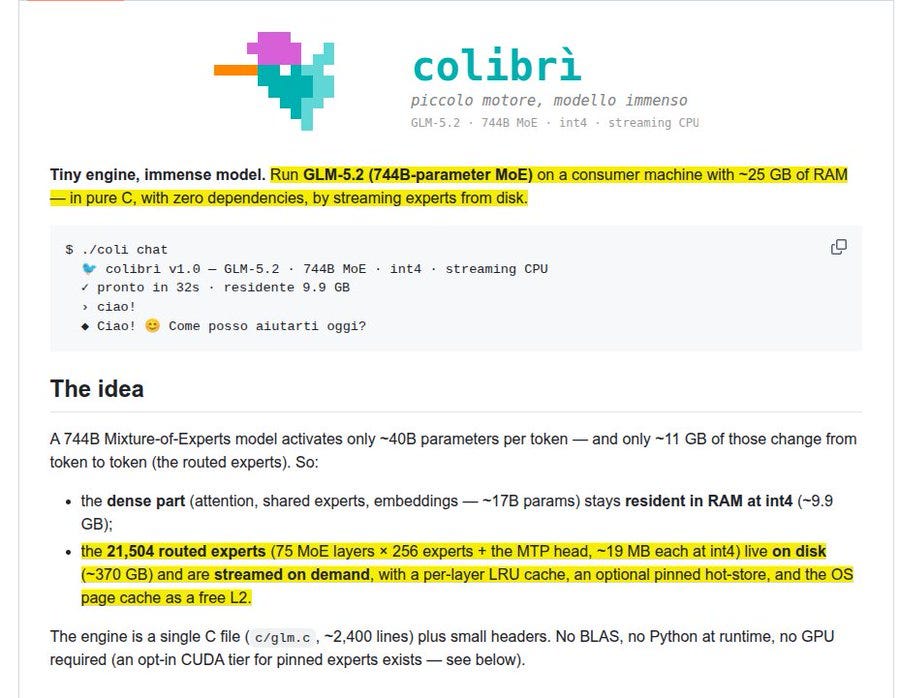
Very slow, but possible.
MoE changes the memory requirement because each token activates about 40B parameters, not the full model. Colibrì keeps the dense tensors resident in RAM, including attention, embeddings, and shared components.
Those resident tensors take about 9.9GB after int4 quantization. The routed experts stay on local NVMe storage as a roughly 370GB int4 model.
During decoding, the router selects experts for each MoE layer and token. The runtime then loads only those selected expert weights from disk.
This works because inactive experts do not need to occupy RAM. The main drawback is throughput, not correctness or model size.
A cold token can require about 11GB of expert reads across 75 MoE layers. That creates very low cold decoding speed, around 0.05 to 0.1 tokens per second.
The system reduces this cost with LRU expert caching, pinned hot experts, and OS page cache reuse. Compressed MLA KV cache also lowers memory pressure during long context generation.
MTP speculative decoding can improve tokens per forward once the cache is warm. The same speculation can hurt cold-cache latency because draft verification may load extra experts.
So the design is only possible because MoE sparsity reduces active parameters per token. The cost is that SSD bandwidth, cache hit rate, and CPU matmul speed dominate latency.
🗞️ A new family of open, commercially available embedding models built for agentic retrieval, code retrieval, and agent memory.
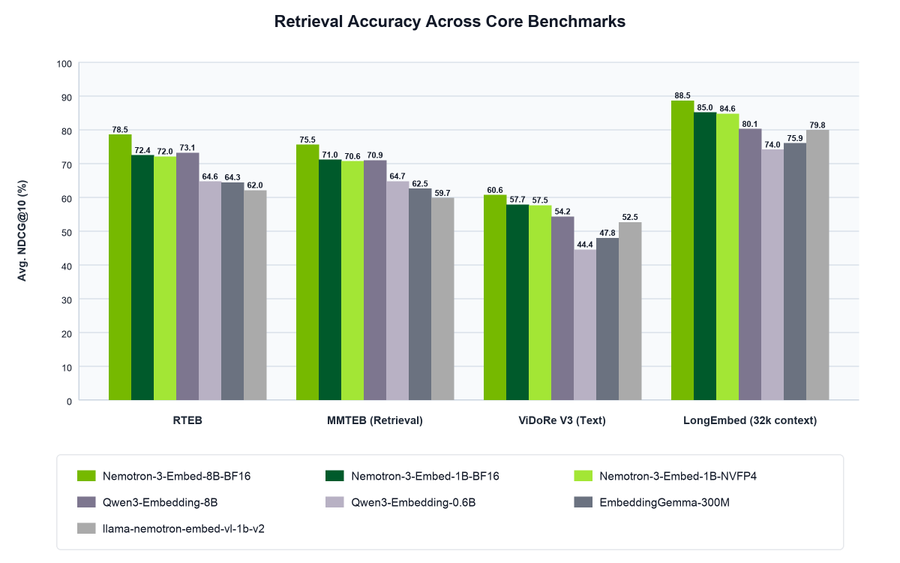
NVIDIA Nemotron-3-Embed-8B-BF16 now ranks first on RTEB with a 78.5% retrieval score.
RTEB is a RAG retrieval leaderboard, showing how reliably a model finds the right context. When retrieval fails, agents get irrelevant evidence, leading to more searches, longer reasoning and higher token bills.
NVIDIA Nemotron 3 Embed breaks that bottleneck with one 8B model and two 1B alternatives. The NVIDIA Nemotron-3-Embed-1B-BF16 achieved a 72.4% score on RTEB, a 27% reduction in error rate over its predecessor.
A full family across the accuracy-efficiency curve - the 8B flagship plus two efficient 1B variants: 1B-BF16 for cost- and latency-sensitive serving, and 1B-NVFP4, a Blackwell-optimized build with up to 2x higher throughput that retains 99%+ of BF16 accuracy. The 1B version, Nemotron-3-Embed-1B-NVFP4 maintains over 99% BF16 accuracy and can handle up to twice as much BF16 traffic.
All three models can take up to 32K tokens as input, which can be long documents, code or agent histories. Created by NVIDIA using structured pruning, teacher distillation and longer and longer training contexts, NVIDIA Nemotron-3-Embed-1B-BF16. Tests with the NVIDIA Nemotron 3 Ultra showed that improved retrieval led to fewer searches and lower token costs.
🗞️ AI agent does not remove the necessity of engineering automation. They are worth much more: Creator & Head of Claude Code at Anthropic
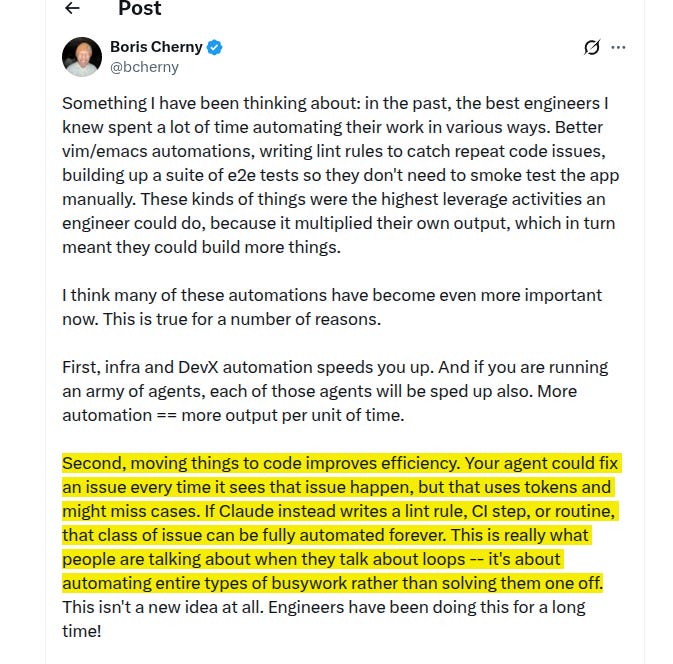
The biggest change is that we can now encode far more than code rules.
e.g. `claude.md` can now contain architectural preferences, review standards, product limitations, hard-won domain knowledge, agent skills and so many more things.
🗞️ SpaceXAI actually open-sourced Grok Build with Apache 2.0 license. 39 mints and 1.9K+ Github stars.
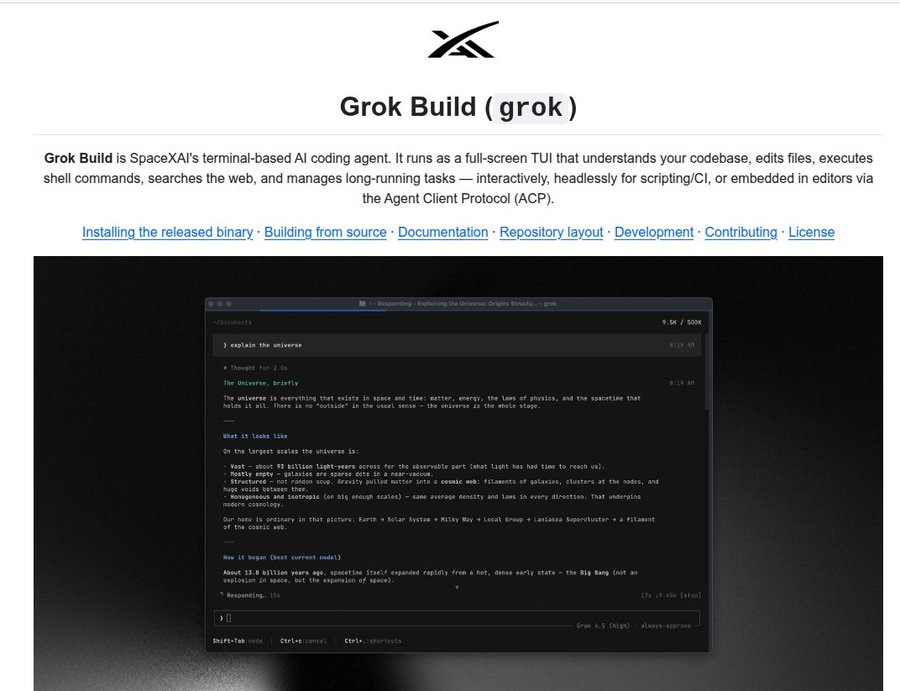
So now can look into the the harness/agent machinery behind its terminal coding system.
They also reset every user's usage allowance. The published Rust code covers the agent loop, file tools, shell execution, web search, and terminal interface.
Users can compile it themselves, connect local inference, and control behavior through config.toml. Apache 2.0 permits modification and redistribution, giving companies freedom to audit or fork the software.
External contributions remain closed, while the public repository syncs periodically from an internal monorepo. Independent forks can still test different reliability designs, but shared upstream development remains limited.
🗞️ Why “technology always creates new jobs” will not work this time.

- From ex-OpenAI researcher Daniel Kokotajlo, and the founder of the AI Futures Project.
Previous technological automation replaced particular tasks while leaving humans better at the new ones that emerged. Superintelligence, by definition, breaks that pattern because it is, by definition, better than humans across every task—not merely the old jobs.
He is the founder of the AI Futures Project, and the lead author of 'AI 2027,’ the famous report mapping the trajectory of AI. From "The Diary Of A CEO" YouTube channel
🗞️ OpenAI just launched its first hardware, codex Micro, a $230 desktop controller for managing workflow.
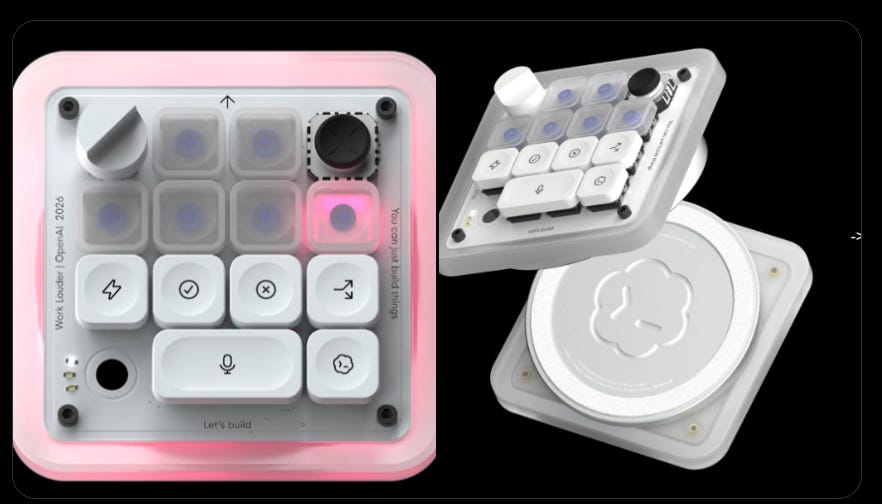
6 translucent keys and the joystick launches common workflows, like PR review, debugging, and code refactoring.
Dedicated controls handle accept, reject, push-to-talk, and new-chat actions from the desk. A rotary dial changes reasoning level. The hardware connects through Bluetooth or USB-C and supports both Mac and Windows. However, personally, I would have really liked a completely hands-free operation for moving faster.
That’s a wrap for today, see you all tomorrow.